Stop Messaging Your Entire Studio: How to Send the Right Message to the Right People
7 October 2026
Jonathan Nelson

Every studio has messages that genuinely matter: a cancelled class, a room change, an instructor update or something important about a booking.
The problem is that those messages often arrive through the same channels as promotions, timetable updates and general studio news.
If too many of those messages aren't relevant, the important ones become easier to miss.
So good studio communication isn't really just about writing better messages. It's about making a few good decisions before you hit send.
We think there are four worth paying attention to:
- Audience: who actually needs to receive it?
- Urgency: how quickly do they need to see it?
- Complexity: how much information do you need to get across?
- Purpose: is the message operational or promotional?
Take a simple example.
Tuesday night's Pilates class has moved rooms.
The audience is obvious: the people attending Tuesday night's class.
The harder part is doing that consistently when you're managing hundreds of clients, changing bookings, multiple classes, different passes and everyone's communication preferences.
That's where the system behind your communication starts to matter.
PassM8 is studio management software for class-based businesses. Its messaging tools connect SMS and email with the class, pass and client information already used to run your studio, so you can use the information that's already there when deciding who to contact.
Start with relevance, not reach
There is a big difference between being able to contact someone and actually having a useful reason to.
Research into SMS advertising gives us a useful example. Kaan Varnali's study in the Journal of Marketing Communications looked at the relationship between message relevance, perceived intrusiveness and people's attitudes towards SMS advertising.[1]
The study is about advertising, not studio notifications, so we're not suggesting the situations are identical.
But the takeaway is still useful:
relevance changes how an interruption feels.
For studios, that means the best question isn't always:
How many clients can we reach?
A better one is:
Who actually needs this message?
| Update | Relevant audience |
|---|---|
| A class has been cancelled | Clients booked into that class |
| A room or instructor has changed | Clients attending the affected class |
| A pass is changing | Clients using the affected pass |
| The studio is closing for a public holiday | Everyone affected by the closure |
| A workshop is opening | Relevant clients who can receive promotional communication |
Sometimes the answer genuinely is everyone.
The point is simply that "everyone" should be a choice, not the default.
Match the channel to the job
SMS and email aren't really competing with each other.
They're useful for different things.
One established way of thinking about this is Media Synchronicity Theory, developed by Alan Dennis, Robert Fuller and Joseph Valacich.[2]
That sounds more academic than it needs to.
The basic idea is simple: different communication channels are good at different jobs, and the best channel depends on what you're trying to communicate.
For a studio, we think two things matter most:
How urgent is it?
and
How much information do you need to get across?
| Urgency | Complexity | Practical approach |
|---|---|---|
| High | Low | SMS |
| Low | High | |
| High | High | SMS alert supported by a detailed email |
| Low | Low | Choose based on context and client expectations |
A last-minute room change is urgent but simple:
Tonight's 6pm Pilates class has moved to Studio 2. Everything else remains the same. See you tonight!
That's a good job for SMS.
A new term timetable, policy update or something with several links and dates is usually better suited to email.
The interesting case is when something is both urgent and detailed.
You don't have to squeeze everything into one SMS.
The SMS can simply get their attention:
Important update for Saturday's workshop. We've emailed you the new venue details and arrival information.
Then the email can do the heavier lifting.
That's a much more useful way to think about SMS and email than trying to decide which one is "better".
Targeting should make sense to the person receiving it
Modern software can segment customers in incredibly specific ways.
That doesn't mean you always should.
A 2026 Journal of Marketing meta-analysis looked at 1,536 effect sizes from 290 studies across 229 papers and found an overall positive effect from personalised marketing communication.[3]
But there was an important catch.
The results also varied depending on things like the type of data being used.
Other research has found something similar from a different angle. A study published in the Journal of Retailing found that the way customer information was collected could influence how comfortable people felt with personalised advertising and how they responded to it.[4]
Again, these studies are about marketing rather than studio management.
But there's a really useful principle here for studios:
use information where the reason for using it is obvious.
If someone receives a message because:
You're booked into Tuesday's 6pm Pilates class.
that makes complete sense.
The same goes for a pass they use, a booking they've made or a class they're enrolled in.
It's much easier for someone to understand why they've received the message.
That's different from using every bit of information you have about a client simply because the software lets you.
The goal isn't to make every message as personalised as possible.
It's to make it relevant to the situation.
Keep operational messages separate from marketing
One of the more important distinctions in studio communication isn't SMS versus email.
It's operational versus promotional.
Compare:
Tonight's class has moved to Studio 2.
with:
Registrations are now open for our new Saturday workshop.
They might go to some of the same people, but they're doing very different jobs.
For Australian studios, that distinction can also matter legally.
ACMA says an electronic message can be considered commercial if it contains promotional or sales content, even if the main purpose of the message is factual.[5]
That can also include links to promotional material.
And this isn't just a technical edge case.
In March 2026, Lululemon Australia paid a $702,900 penalty after an ACMA investigation into more than 370,000 emails containing commercial content without an unsubscribe facility. Some were service messages, including order confirmations and shipping updates, that also contained sales material or direct links to promotions.[6]
There's a pretty practical lesson in that for studios:
not every operational message needs to become a marketing opportunity.
A class cancellation doesn't need a workshop promotion underneath it.
A payment confirmation doesn't need an upsell.
A timetable change doesn't need a new-member offer.
Keeping those messages separate makes things clearer for clients, and it can also make consent and unsubscribe requirements easier to manage.
ACMA specifically recommends keeping service or factual messages separate from messages containing or linking to promotional content.[5]
Commercial electronic messages generally need consent, accurate sender information and a functioning unsubscribe facility under Australia's spam rules.[5]
In PassM8, messages can be marked as Marketing or Service Notices (Operational), which helps studios apply promotional communication preferences when deciding who should receive a message.
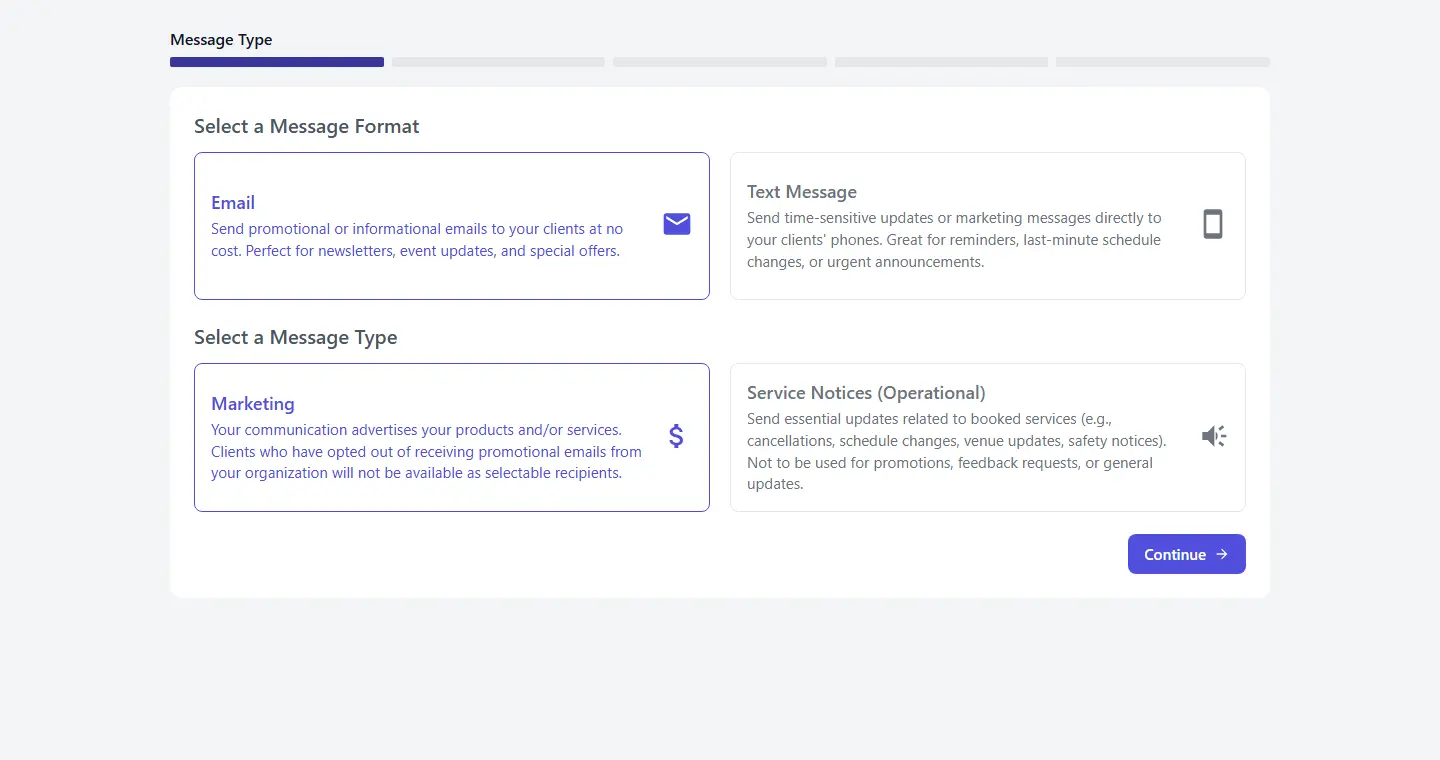
PassM8 separates message format from message purpose, so studios can choose how a message is delivered and whether it is marketing or operational.
That setting helps with the process, but it doesn't decide whether a message is legally commercial. Studios are still responsible for making sure the messages they send meet the relevant requirements.
Static contact lists get old quickly
This is one of the bigger practical problems with studio communication.
Most studio audiences are constantly changing.
Someone joins Tuesday Pilates.
Someone else cancels.
A client changes classes.
A pass expires.
Another gets renewed.
A new booking comes in.
So a list called:
Tuesday Pilates Clients
can become outdated pretty quickly if someone has to maintain it manually.
There's a useful difference here between a contact list and an operational audience.
A contact list tells you:
Who did we add to this list?
An operational audience tells you:
Who actually fits this group right now?
For studio communication, that second question is often much more useful.
Instead of maintaining a separate list for Tuesday Pilates, your system should be able to work out:
Who is currently attending Tuesday Pilates?
when you're ready to send the message.
The same applies to passes and other groups.
This is where having communication connected to your studio management system becomes much more useful than simply having an email tool built in.
The real value isn't that you can send an email from the same software. It's that the audience can come from the same live information you're already using to run the studio.
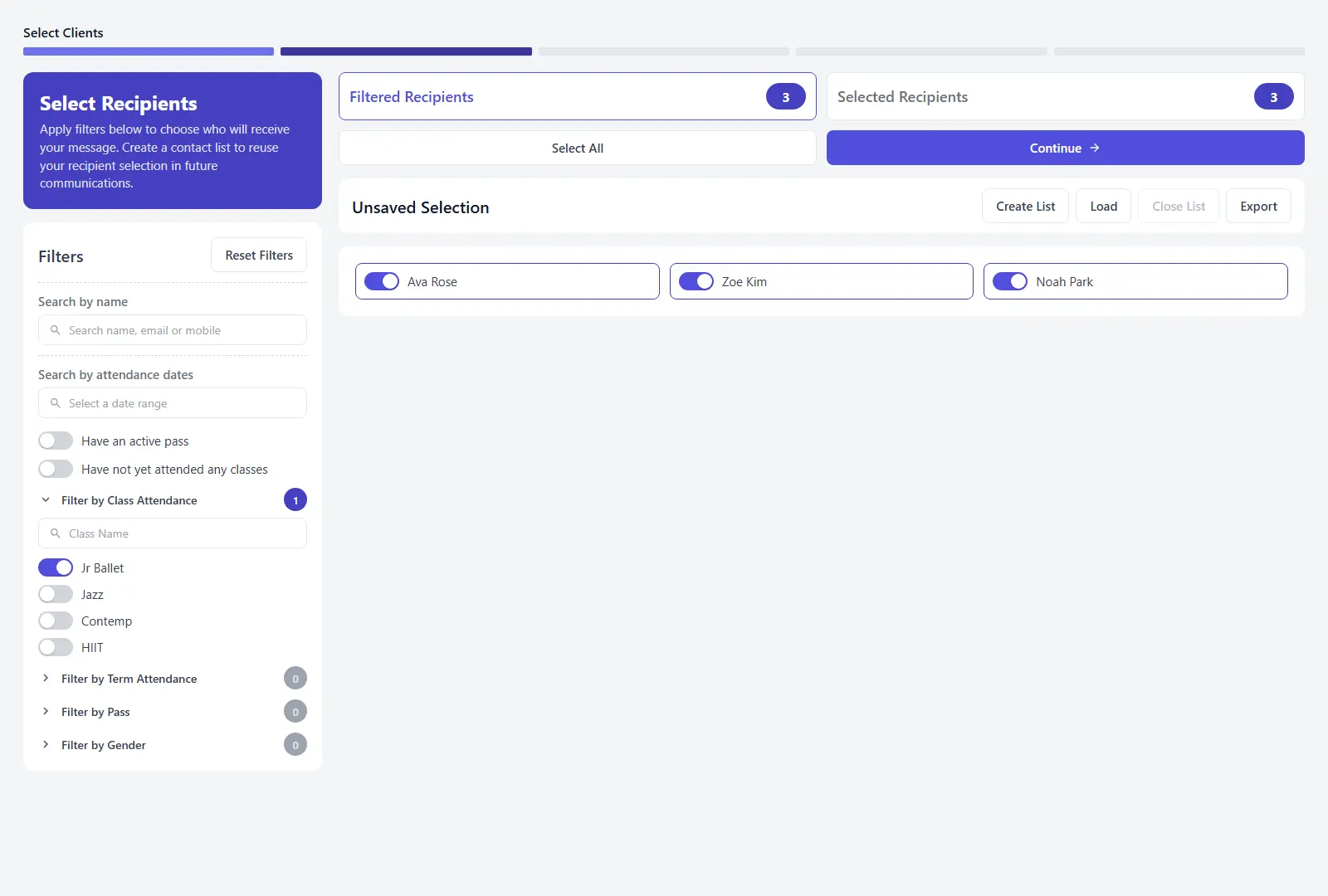
Recipient filters in PassM8 can use current studio information, such as class attendance and passes, to build the relevant audience.
That means less duplicated data, fewer lists to maintain and less chance of messaging someone based on information that's no longer current.
How PassM8 puts this into practice
PassM8 connects messaging with the classes, passes and clients already managed in the platform.
That means the four decisions we started with can flow naturally into the way you send a message.
| Decision | In PassM8 |
|---|---|
| Audience | Target using information such as a client's class or pass |
| Urgency and complexity | Choose between SMS and email |
| Purpose | Identify the message as Promotional or Non-promotional |
| Communication preferences | Promotional opt-outs can be excluded from promotional messages |
So if a class changes, you can contact the clients associated with that class.
If an update affects people using a particular pass, you can target that group.
If you're promoting a workshop or offer, promotional communication preferences can be taken into account.
And when something genuinely affects the whole studio, you can communicate more broadly.
The aim isn't to create increasingly complicated segments.
It's simply to make the information already in your studio useful when you need to communicate.
Good communication protects your clients' attention
Studios don't necessarily need to send fewer messages.
They just need the messages they send to feel worthwhile.
For us, that comes back to four things:
Audience. Urgency. Complexity. Purpose.
Send the message to the people it affects.
Choose the channel that suits the job.
Use client information when there's a clear reason for using it.
Keep operational communication separate from promotion.
And where possible, build your audience from the current information already being used to run the studio.
The result is communication that's more relevant for clients, easier for your team to manage as the studio grows, and comes with less admin and less risk of communicating with the wrong people.
That's the kind of communication PassM8 is designed to support.
See how messaging works in PassM8
PassM8 brings classes, passes, clients and communication tools together so studios can send targeted SMS and email without maintaining separate contact lists.
If you'd like to see how messaging could work with the way your studio already operates, book a one-on-one demo and we'll walk you through it.
Frequently asked questions
Should a studio use SMS or email for class changes?
For short, time-sensitive changes like a cancellation, room change or instructor change, SMS is usually the more practical option.
If there's more detail involved, email can carry the full update, with SMS used to draw attention to it when the information is urgent.
Can a factual studio message still be considered commercial in Australia?
Yes. ACMA says a message can be commercial if it contains promotional or sales material, even if the main purpose is factual. Direct links to promotional material can also affect how the message is classified.[5]
How can studios target messages without maintaining separate contact lists?
One option is to build the audience from current studio information instead of maintaining separate static groups.
For example, a studio management system can use current class or pass information to work out which clients are relevant when the message is sent.
Can PassM8 send messages to clients in a particular class or using a particular pass?
Yes. PassM8 can use class and pass information already stored in the platform to help select the relevant clients for an SMS or email.
How does PassM8 handle promotional opt-outs?
Messages in PassM8 can be marked as promotional or non-promotional. When promotional communication is being sent, clients who have opted out of promotional messages can be excluded from the audience.
Sources & further reading
[1] Varnali, K. (2014). SMS Advertising: How Message Relevance Is Linked to the Attitude Toward the Brand? Journal of Marketing Communications, 20(5), 339-351.
[2] Dennis, A. R., Fuller, R. M. & Valacich, J. S. (2008). Media, Tasks, and Communication Processes: A Theory of Media Synchronicity. MIS Quarterly, 32(3), 575-600.
[3] Eisend, M., Niewiadomska, D. & van Noort, G. (2026). Personalization in Marketing Communication: A Meta-Analysis. Journal of Marketing.
[4] Aguirre, E., Mahr, D., Grewal, D., de Ruyter, K. & Wetzels, M. (2015). Unraveling the Personalization Paradox: The Effect of Information Collection and Trust-Building Strategies on Online Advertisement Effectiveness. Journal of Retailing, 91(1), 34-49.
[5] Australian Communications and Media Authority. Guidance on factual and commercial electronic messages, consent, sender identification and unsubscribe requirements under the Spam Act 2003.
[6] Australian Communications and Media Authority (11 March 2026). Lululemon penalised $702K for spam breaches.
Jonathan Nelson
TBA
TBA